Dream of a Baby With Sores on Skin
We include products nosotros think are useful for our readers. If yous buy through links on this folio, we may earn a small commission. Here'due south our process.
Dreams are stories and images that our minds create while nosotros slumber. They can be entertaining, fun, romantic, agonizing, frightening, and sometimes baroque.
They are an indelible source of mystery for scientists and psychological doctors. Why do dreams occur? What causes them? Can we control them? What exercise they mean?
This article will explore the current theories, causes, and applications of dreaming.

Dreams: Do they correspond our unconsious desires?
There are several theories about why we dream. Are dreams merely part of the sleep wheel, or practice they serve another purpose?
Possible explanations include:
- representing unconscious desires and wishes
- interpreting random signals from the brain and torso during sleep
- consolidating and processing information gathered during the day
- working every bit a class of psychotherapy
From evidence and new research methodologies, researchers have speculated that dreaming serves the following functions:
- offline memory reprocessing, in which the brain consolidates learning and retentivity tasks and
supports and records waking consciousness - preparing for
possible time to come threats - cognitive simulation of real life experiences, every bit dreaming is a subsystem of the waking default network, the office of the mind active during heedless
- helping
develop cognitive capabilities - reflecting
unconscious mental function in a psychoanalytic way - a unique country of consciousness that
incorporates experience of the present, processing of the past, and preparation for the futurity - a psychological infinite where overwhelming, contradictory, or highly complex notions can be
brought together by the dreaming ego, notions that would exist unsettling while awake, serving the need for psychological balance and equilibrium
Much that remains unknown about dreams. They are past nature difficult to study in a laboratory, only engineering science and new inquiry techniques may help improve our understanding of dreams.
Phases of sleep
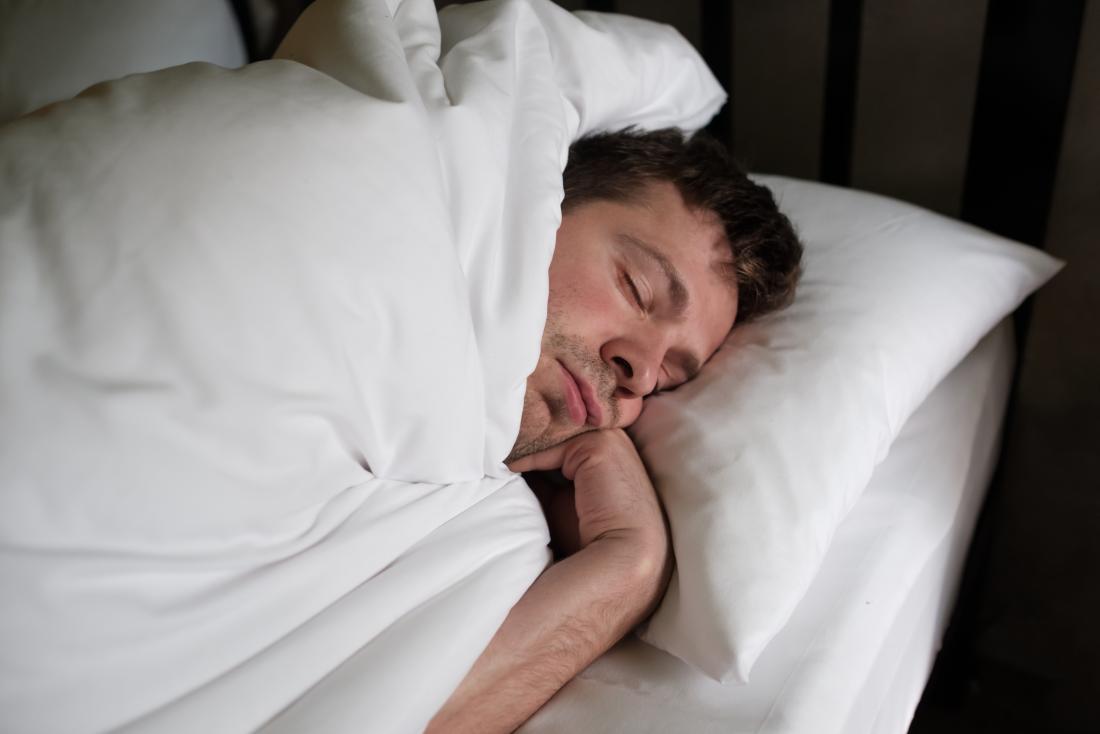
Dreams most likely happen during REM sleep.
In that location are five phases of sleep in a sleep cycle:
Phase 1: Calorie-free sleep, slow middle movement, and reduced muscle action. This stage forms 4 to five percent of total slumber.
Phase two: Eye movement stops and brain waves become slower, with occasional bursts of rapid waves called sleep spindles. This stage forms 45 to 55 percent of total sleep.
Stage iii: Extremely irksome brain waves called delta waves begin to appear, interspersed with smaller, faster waves. This accounts for 4 to six percent of total slumber.
Phase 4: The brain produces delta waves almost exclusively. Information technology is hard to wake someone during stages 3 and 4, which together are chosen "deep sleep." There is no eye motion or muscle activity. People awakened while in deep sleep do not adjust immediately and often feel disoriented for several minutes later on waking upwards. This forms 12 to 15 per centum of total sleep.
Phase 5: This stage is known as rapid eye movement (REM). Animate becomes more rapid, irregular, and shallow, eyes jerk quickly in diverse directions, and limb muscles become temporarily paralyzed. Heart charge per unit increases, blood pressure rises, and males develop penile erections. When people awaken during REM sleep, they often describe bizarre and casuistic tales. These are dreams. This stage accounts for 20 to 25 percentage of total sleep time.
Neuroscience offers explanations
Dreams are a universal human experience that can exist described equally a state of consciousness characterized by sensory, cognitive and emotional occurrences during sleep.
The dreamer
In that location is
There are meaning differences between the neuroscientific and psychoanalytic approaches to dream analysis.
Neuroscientists are
Reports of dreams
These elements create a novel "reality" out of seemingly nothing,
Nightmares
Nightmares are distressing dreams that crusade the dreamer to experience a number of disturbing emotions. Common reactions to a nightmare include fear and anxiety.
They tin occur in both adults and children, and causes include:
- stress
- fear
- trauma
- emotional difficulties
- illness
- use of sure medications or drugs
Lucid dreams
Lucid dreaming is the dreamer is aware that they are dreaming. They may have some control over their dream.
This measure out of command can vary between lucid dreams. They ofttimes occur in the centre of a regular dream when the sleeping person realizes suddenly that they are dreaming.
Some people experience lucid dreaming at random, while others have reported being able to increment their capacity to control their dreams.
What goes through our minds just before we autumn comatose could impact the content of our dreams.
For case, during exam time, students may dream about course content. People in a relationship may dream of their partner. Spider web developers may run into programming code.
These coexisting observations suggest that elements from the everyday re-emerge in dream-like imagery during the transition from wakefulness to sleep.
Characters
Studies take examined the "characters" that appear in dream reports and how they the dreamer identifies them.
A study of
- Forty-eight percent of characters represented a named person known to the dreamer.
- Thirty-five percent of characters were identified by their social role (for case, policeman) or human relationship to dreamer (such every bit a friend).
- Sixteen percent were non recognized
Among named characters:
- Thirty-two percentage were identified past appearance
- Twenty-one percentage were identified by behavior
- Twoscore-five percent were identified by face
- Twoscore-four percentage were identified past "merely knowing"
Elements of bizarreness were reported in xiv percent of named and generic characters.
Another study investigated the relationship betwixt dream emotion and dream graphic symbol identification.
Affection and joy were ordinarily associated with known characters and were used to identify them even when these emotional attributes were inconsistent with those of the waking land.
The findings advise that the dorsolateral prefrontal cortex, associated with short-term memory, is less active in the dreaming encephalon than during waking life, while the paleocortical and subcortical limbic areas are more active.
Memories
The concept of 'repression' dates dorsum to Freud. Freud maintained that undesirable memories could get suppressed in the mind. Dreams ease repression by allowing these memories to be reinstated.
A study showed that sleep
Two types of temporal effects characterize the incorporation of memories into dreams:
- the mean solar day-residue event, involving firsthand incorporations of events from the preceding day
- the dream-lag effect, involving incorporations delayed by about a week
The
- processing memories into dream incorporation takes a cycle of around seven days
- these processes help further the functions of socio-emotional adaptation and memory consolidation
Dream lag
Dream-lag is when the images, experiences, or people that sally in dreams are images, experiences, or people you have seen recently, perhaps the previous day or a calendar week before.
The thought is that certain types of experiences have a week to become encoded into long-term retention, and some of the images from the consolidation process volition appear in a dream.
Events experienced while awake are said to feature in i to 2 percent of dream reports, although 65 pct of dream reports reverberate aspects of recent waking life experiences.
The dream-lag result
Memory types and dreaming
Two types of memory tin form the basis of a dream.
These are:
- autobiographical memories, or long-lasting memories about the self
- episodic memories, which are memories about specific episodes or events
A study exploring different types of retentiveness inside dream content amid 32 participants
- 1 dream (0.5 percent) contained an episodic retentivity.
- Almost dreams in the study (80 percent) contained low to moderate incorporations of autobiographical memory features.
Researchers suggest that memories of personal experiences are experienced fragmentarily and selectively during dreaming. The purpose may exist to integrate these memories into the long-lasting autobiographical memory.
A hypothesis stating that dreams reflect waking-life experiences is supported by studies investigating the dreams of psychiatric patients and patients with sleep disorders. In short, their daytime symptoms and problems
In 1900, Freud described a category of dreams known as "biographical dreams." These reflect the historical experience of being an infant without the typical defensive function. Many authors agree that some traumatic dreams perform a function of recovery.
One newspaper
Themes
The themes of dreams can be linked to the suppression of unwanted thoughts and, equally a outcome, an increased occurrence of that suppressed thought in dreams.
Fifteen good sleepers were asked to suppress an unwanted idea five minutes prior to sleep.
The
Inquiry
For example, the positively-toned stimulus of roses in one study yielded more positively themed dreams, whereas the negative stimulus of rotten eggs was followed past more than negatively themed dreams.
Typical dreams are defined equally dreams like to those reported past a high percentage of dreamers.
Up to now, the frequencies of typical dream themes have been studied with questionnaires. These

Some themes are familiar to many people, such as flying, falling, and arriving late.
The 55 themes identified are:
- school, teachers, and studying
- being chased or pursued
- sexual experiences
- falling
- arriving too late
- a living person being dead
- a person at present dead being live
- flying or soaring through the air
- declining an examination
- being on the verge of falling
- existence frozen with fear
- being physically attacked
- being nude
- eating delicious food
- swimming
- being locked up
- insects or spiders
- existence killed
- losing teeth
- beingness tied upwards, restrained, or unable to move
- existence inappropriately dressed
- beingness a child once again
- trying to consummate a job successfully
- being unable to find toilet, or embarrassment about losing one
- discovering a new room at home
- having superior cognition or mental ability
- losing control of a vehicle
- fire
- wild, violent beasts
- seeing a face very shut to y'all
- snakes
- having magical powers
- vividly sensing, merely non necessarily seeing or hearing, a presence in the room
- finding coin
- floods or tidal waves
- killing someone
- seeing yourself as dead
- being half-awake and paralyzed in bed
- people behaving in a menacing manner
- seeing yourself in a mirror
- being a member of the opposite sex
- being smothered, unable to breathe
- encountering God in some grade
- seeing a flying object crash
- earthquakes
- seeing an affections
- part creature, role human creatures
- tornadoes or strong winds
- being at the film
- seeing extra-terrestrials
- traveling to some other planet
- being an animal
- seeing a UFO
- someone having an abortion
- being an object
Some dream themes appear to change over time.
For example, from 1956 to 2000, at that place was
What practise they mean?
Relationships: Some have hypothesized that 1 cluster of typical dreams, including existence an object in danger, falling, or being chased, is related to interpersonal conflicts.
Sexual concepts: Another cluster that includes flying, sexual experiences, finding money, and eating delicious nutrient is associated with libidinal and sexual motivations.
Fearfulness of embarrassment: A third group, containing dreams that involve being nude, failing an exam, arriving too late, losing teeth, and beingness inappropriately dressed, is associated with social concerns and a fear of embarrassment.
Brain activity and dream types
In neuroimaging studies of brain action during REM sleep, scientists found that the distribution of brain activity might besides be linked to specific dream features.
Several bizarre features of normal dreams
Dreams and the senses
Dreams were evaluated in people experiencing unlike types of headache. Results showed people with migraine had increased frequency of dreams involving taste and scent.
This
Music in dreams is rarely studied in scientific literature. However, in a written report of 35 professional person musicians and 30 non-musicians, the musicians
Musical dream frequency was related to the age of commencement of musical instruction just not to the daily load of musical activity. Nearly one-half of the recalled music was not-standard, suggesting that original music tin be created in dreams.
Pain
Information technology has been shown that realistic, localized painful sensations tin can exist experienced in dreams, either through straight incorporation or from memories of pain. However, the frequency of pain dreams in healthy subjects is low.
In one study, 28 non-ventilated burn victims were interviewed for five consecutive mornings during their first week of hospitalization.
Results
- Thirty-nine percentage of people reported pain dreams.
- Of those experiencing pain dreams, xxx percent of their total dreams were hurting-related.
- Patients with hurting dreams showed evidence of reduced sleep, more than nightmares, college intake of anxiolytic medication, and higher scores on the Impact of Event Scale.
- Patients with pain dreams besides had a tendency to study more intense hurting during therapeutic procedures.
More than than one-half did not report pain dreams. Notwithstanding, these results could suggest that pain dreams occur at a greater frequency in populations currently experiencing hurting than in normal volunteers.
Self-awareness
1 study
The written report found that current stimulation in the lower gamma band during REM sleep influences on-going brain activity and induces self-reflective awareness in dreams.
Researchers concluded that higher lodge consciousness is related to oscillations around 25 and 40 Hz.
Relationships
Recent research has demonstrated parallels between styles of romantic attachment and general dream content.
Assessment results from 61 student participants in committed dating relationships of 6 months elapsing or longer revealed
The findings illuminate our understanding of mental representations with regards to specific attachment figures.
Expiry in dreams
Researchers compared the dream content of different groups of people in a psychiatric facility. Participants in one group had been admitted afterwards attempting to take their own lives.
Their dreams of this group were compared with those of three command groups in the facility who had experienced:
- depression and thoughts well-nigh suicide
- depression without thinking nearly suicide
- carrying out a violent act without suicide
Those who had considered or attempted suicide or carried out violence had were
Left and right side of the brain
The correct and left hemispheres of the brain seem to contribute in different ways to a dream formation.
Researchers of one study
A report of adolescents aged 10 to 17 years constitute that those who were left-handed were more than likely to feel lucid dreams and to remember dreams within other dreams.
Studies of brain activity suggest that most people over the age of 10 years dream between 4 and 6 times each night, but some people rarely call back dreaming.
It is often said that 5 minutes afterwards a dream, people have forgotten 50 percent of its content, increasing to 90 percent another five minutes later on.
Near dreams are entirely forgotten by the time someone wakes up, only it is not known precisely why dreams are so hard to call back.
Steps that may help improve dream think, include:
- waking up naturally and not with an alarm
- focusing on the dream as much as possible upon waking
- writing downward as much about the dream equally possible upon waking
- making recording dreams a routine
Who remembers their dreams?
There are factors that tin can potentially influence who remembers their dreams, how much of the dream remains intact, and how vivid information technology is.
Age: Over time, a person is probable to feel changes in slumber timing, construction, and electroencephalographic (EEG) activeness.
Evidence
Gender: A study of dreams experienced by 108 males and 110 females found no differences between the corporeality of assailment, friendliness, sexuality, male characters, weapons, or wearing apparel that feature in the content.
However, the dreams of females
Sleep disorders: Dream retrieve is heightened in patients with insomnia, and their dreams reflect the stress associated with their status. The dreams of people with narcolepsy may a
Dream recall and well-existence
One study looked at whether dream recall and dream content would reflect the social relationships of the person who is dreaming.
College student volunteers
Participants who were classified as "high" on an "insecure attachment" scale were significantly more than likely to:
- written report a dream
- dream frequently
- experience intense images that contextualize strong emotions in their dreams
Older volunteers whose attachment way was classed as "preoccupied" were significantly more than likely to:
- written report a dream
- study dreams with a higher mean number of words
Dream recall was lowest for the "avoidant" subjects and highest for the "preoccupied" subjects.
Everyone dreams, although nosotros may not remember our dreams. At unlike times of life or during different experiencs, our dreams might change.
Children's dreams
A study investigating anxiety dreams in 103 children aged 9 to 11 years
- Females more ofttimes had dreams containing anxiety than males, although they could non remember their dreams every bit often.
- Girls dreamt more often than boys near the loss of another person, falling, socially disturbing situations, small or aggressive animals, family members, and other female people they may or may not recognize.
Pregnancy
Studies
- Infant and child representations were less specific in women who were non meaning. Amongst those who were pregnant, these images were more likely in the tardily third trimester than in the early on third trimester.
- During pregnancy, dreams were more likely to include the themes of pregnancy, childbirth, and fetuses.
- Childbirth content was higher in the late 3rd trimester than early in the trimester.
- The group who were pregnant had more than morbid elements in their dreams than those who were non.
Caregivers
Those that give care to family or people who have long-term illnesses oft have dreams related to that individual.
A study following the dreams of adults that worked for at least a year with individuals at United States hospice centers
- Patients tended to be clearly present in the dreams of caregivers, and the dreams were typically realistic.
- In the dream, the caregiver typically interacted with the patient in their usual chapters but was also typically frustrated by the inability to aid as fully as desired.
Bereavement
It is widely believed that oppressive dreams are frequent in people going through a time of bereavement.
A report analyzing dream quality, as well as the linking of oppressive dreams in bereavement,
- were more than frequent in the first year of bereavement
- were more than likely in those experiencing symptoms of anxiety and depression
In
- L-viii percent reported dreams of their deceased loved ones, with varying levels of frequency.
- Well-nigh participants had dreams that were either pleasant or both pleasant and disturbing, and few reported purely disturbing dreams
- Prevalent themes included pleasant past memories or experiences, the deceased being free of illness, memories of the deceased's illness or time of expiry, the deceased in the afterlife appearing comfortable and at peace, and the deceased person communicating a bulletin.
- Sixty percent felt that their dreams impacted upon their bereavement procedure.
Does everyone dream in color?

Younger people are more probable to dream in color.
Researchers discovered in a study that:
- About lxxx percent of participants younger than 30 years quondam dreamed in color.
- At sixty years quondam, 20 pct said they dreamed in color.
The number of people aged in their 20s, 30s and 40s dreaming in colour increased through 1993 to 2009. Researchers speculated that color television might play a role in the generational difference.
Some other study using questionnaires and dream diaries also found older adults had more than blackness and white dreams than the younger participants.
Older people reported that both their color dreams and black and white dreams were equally bright. Even so, younger participants said that their black and white dreams were of poorer quality.
Tin dreams predict the future?
Some dreams may seem to predict future events.
Some researchers merits to have prove that this is possible, just in that location is not enough evidence to show it.
Most oft, this seems to exist due to coincidence, a false retentiveness, or the unconscious listen connecting together known information.
Dreams may help people learn more about their feelings, beliefs, and values. Images and symbols that appear in dreams will have meanings and connections that are specific to each person.
People looking to brand sense of their dreams should think about what each part of the dreams hateful to them as an private.
Books or guides that requite specific, universal meanings to images and symbols may non be useful.
Nonetheless, for those who are interested in such books, there is a selection bachelor for purchase online.
Drug withdrawal
One
- Almost 90 percent of individuals reported drug-related dreams during the offset month, mainly of using the drug.
- Almost 61 percentage had drug-related dreams after six months, mainly of using or refusing the drug.
People with complete vision loss have fewer visual dream impressions compared with sighted participants.
People who have been unable to see from birth
The ability to see does not appear to affect emotional and thematic dream content.
Those with other abilities
One
Four were born with paraplegia, and ten were born unable to hear or speak.
Deafness: When compared with 36 able-bodied individuals, findings showed that around 80 percent of the dream reports of participants with deafness gave no indication of their damage.
Many spoke in their dreams, while others could hear and empathize spoken language.
Paraplegia: Similarly, the dream reports of those with paraplegia showed that the participants often walked, ran, or swam in their dreams, none of which they had always washed in their waking lives.
A 2nd written report looked at the dream reports of 15 people who were either born with paraplegia or acquired it later in life, due to a spinal-cord injury.
Their
Other research has suggested that the encephalon has the genetically determined ability to generate experiences that mimic life, including fully functioning limbs and senses.
People who are built-in without hearing or unable to move are likely tapping into these parts of the brain as they dream almost tasks they cannot perform while awake.
Read the commodity in Spanish.
Source: https://www.medicalnewstoday.com/articles/284378
0 Response to "Dream of a Baby With Sores on Skin"
Post a Comment